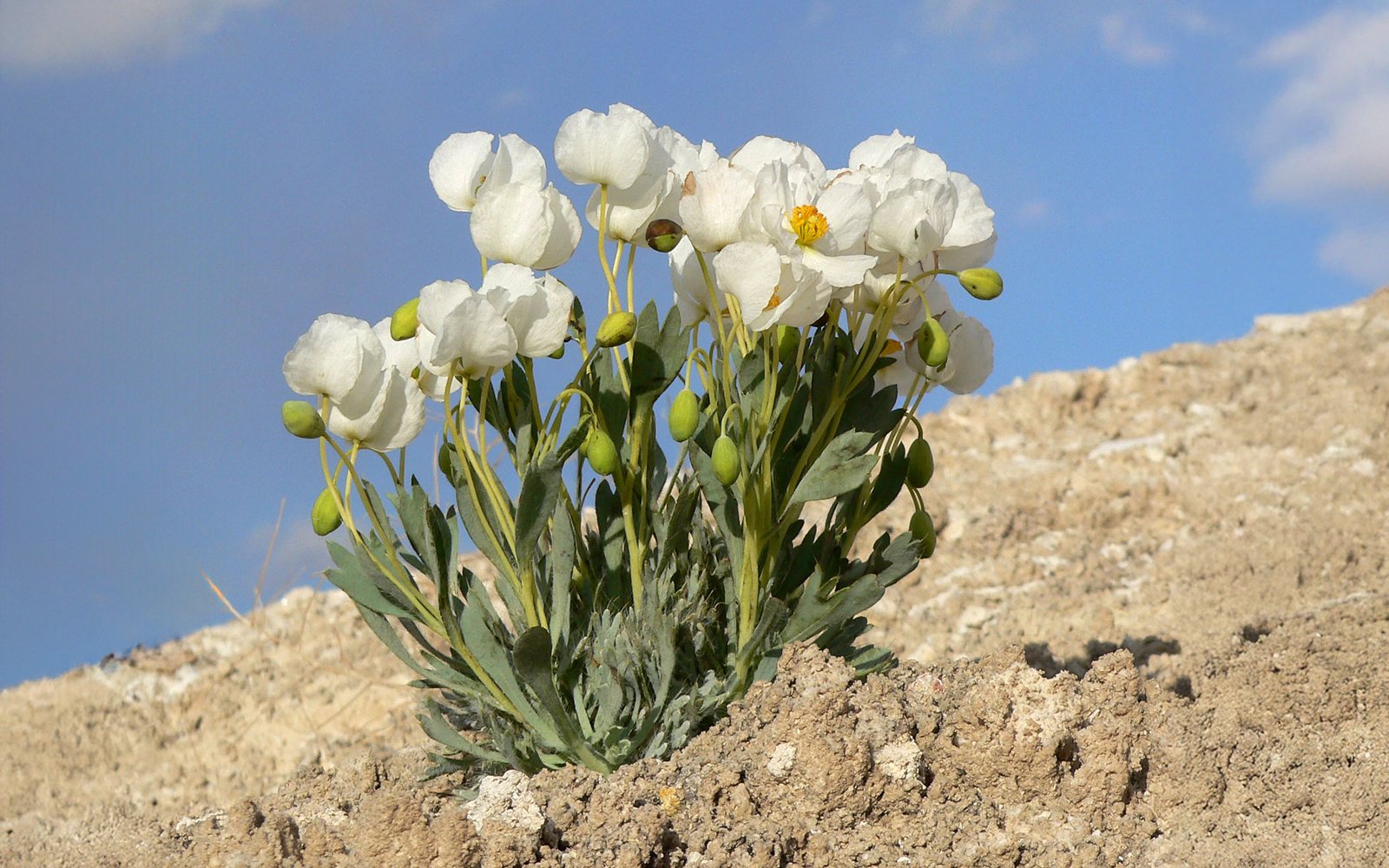
A brilliant white desert flower that grows nowhere else on Earth - only on the gypsum hills around St. George.
The dwarf bear-poppy (Arctomecon humilis) is a true Washington County endemic. Its entire world range is a handful of gypsum badlands within a few miles of town - the kind of harsh, chalky ground most plants can't touch. For a few weeks each spring it erupts in papery white blooms, then retreats. Because it lives in only one small place, what happens to that ground is, quite literally, the whole story of the species.
Named for a bear's paw
The plant grows as a low rosette of blue-green, deeply lobed leaves that fan out like a bear's paw, each lobe tipped with a claw-like silver hair. From that tuft rise slender stems carrying the flowers, so a healthy plant looks like a small bouquet lifted just above the soil.
A brief, brilliant bloom
Flowering is short and spectacular. In April and May a single plant can carry 300-400 white blooms, each with a golden center. The flowers open at dawn and shed their pollen by midday, so the pollinators that depend on them - native bees, mostly - have to arrive early. Miss the window and you'd never know the plant was there.
A gypsum specialist
The bear-poppy is picky in the extreme: it grows almost exclusively on gypsum soils, and it depends on the fragile biological soil crust that binds those soils together. That crust takes decades to form and can be destroyed by a single footprint or tire track - which is exactly why this plant is so easy to lose.
Among the first protected
The dwarf bear-poppy was listed as endangered in 1979, making it one of the very first plants ever protected under the U.S. Endangered Species Act. Its biggest threats are development, off-road vehicles, and gypsum mining - all of which target the same rare soils it needs.
Why it matters here
An endemic species has no backup population somewhere else. If the dwarf bear-poppy disappears from the hills around St. George, it disappears from the planet. Protecting Greater Moe's Valley and its gypsum ground is protecting one of the rarest flowers in the American West.
One rare neighbor among many
The bear-poppy shares this desert with the tortoise, the Gila monster, and a whole community of rare life. Protecting the land protects all of it.
Page for the Save Greater Moe's Valley effort. The dwarf bear-poppy is federally listed as endangered; never pick, dig, trample, or disturb it, and stay on established trails to protect the soil it depends on.