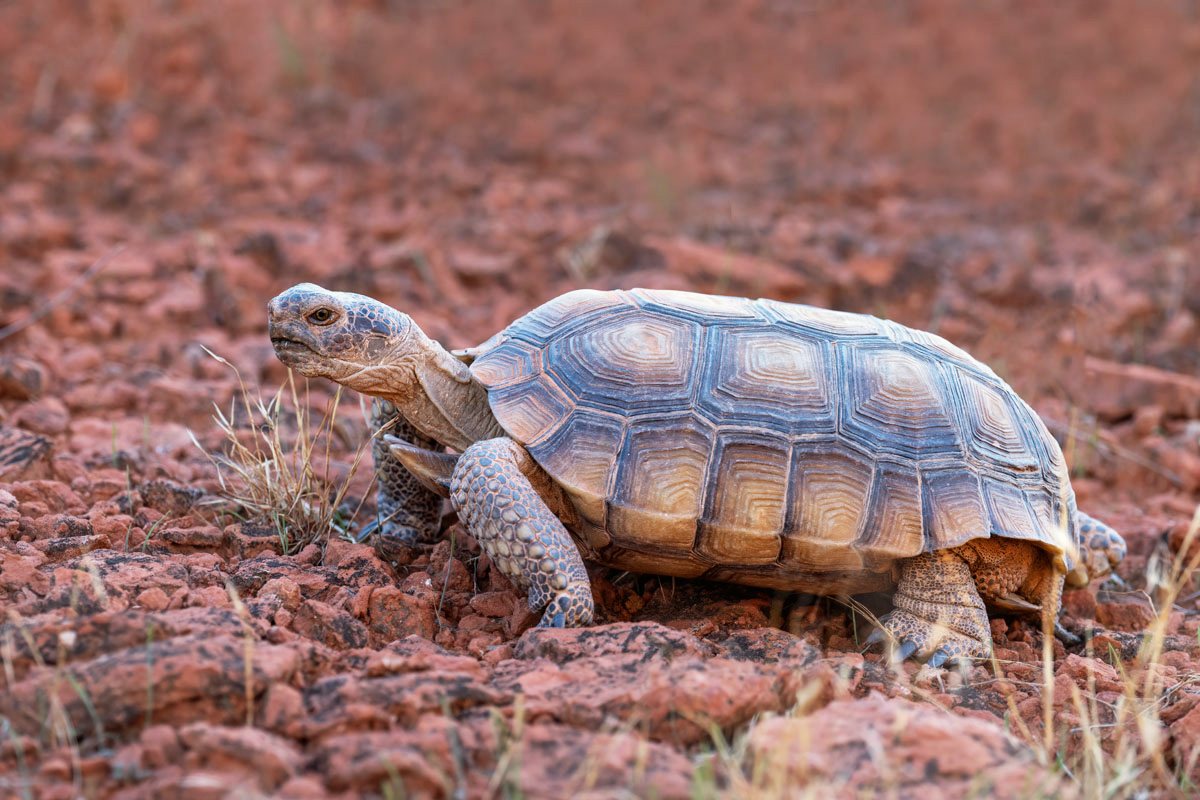
The reason the whole Reserve exists - a slow, ancient desert survivor that spends almost its entire life underground.
The Mojave desert tortoise (Gopherus agassizii) is the keystone the Red Cliffs Desert Reserve was built to protect. It is long-lived, slow to mature, and exquisitely adapted to a place that swings from blistering heat to winter cold - mostly by staying out of both.
A life measured in decades
A wild desert tortoise can live 50 to 80 years, but it doesn't even begin to reproduce until it's 15 to 20 years old. That means a lost population can take generations to return - and can't simply bounce back after a bad decade.
Master of the burrow
Tortoises spend up to 95% of their lives underground, digging burrows that escape the surface extremes. Those burrows do double duty: dozens of other desert species - snakes, lizards, burrowing owls, insects - shelter in them too, which makes the tortoise a true ecosystem engineer.
The bladder that saves - or kills
A tortoise stores water in its bladder to ride out long droughts. If it's startled and handled, it may empty that bladder in self-defense - and in the desert heat, losing that water can be fatal. It's the single biggest reason you should never pick up a wild tortoise.
Under pressure
Desert tortoises face habitat loss, roads and vehicles, disease, and a boom in ravens that prey on hatchlings. The Red Cliffs Desert Reserve - including Zone 6 - was created specifically to give this species room to survive.
One rare neighbor among many
The desert tortoise shares this desert with a whole community of rare life. Protecting the land protects all of it.
Page for the Save Greater Moe's Valley effort. The Mojave desert tortoise is federally threatened; never handle, feed, or move a wild tortoise, and give it a wide berth if you see one crossing a trail or road.